
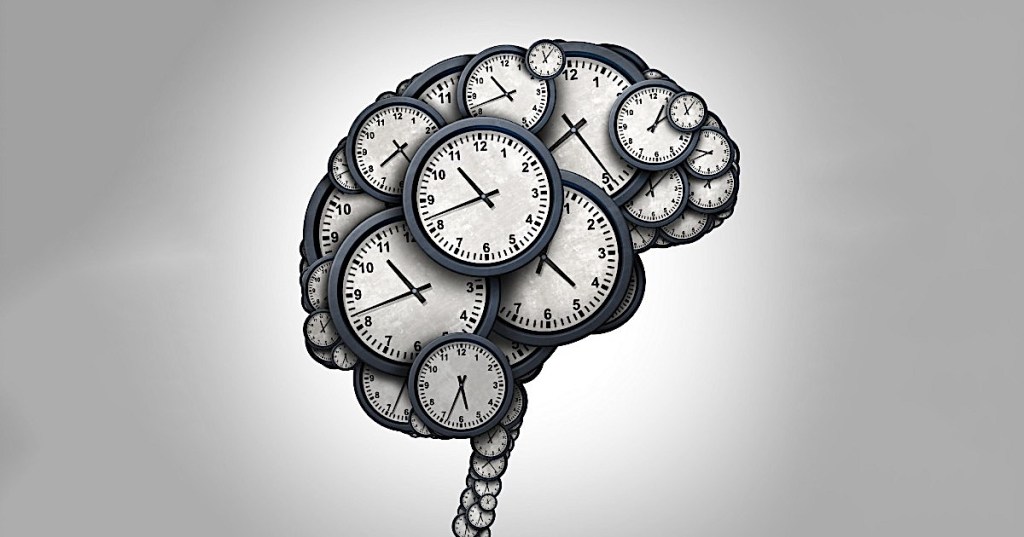
This line of research builds on the foundations laid in the “Neurofilmology” project. Working with a team of psychologists and neuroscientists, I explore how different semiotic and stylistic choices in audiovisual texts shape viewers’ perception of time — specifically, how they influence our estimations of duration and speed. The core hypothesis is that our sense of time is deeply tied to the way we perceive movement: when we watch moving images, our brains mirror that movement, making films and videos powerful “time machines.”
Our earlier project, SEEM_IT (Subjective Experience and Estimation of Moving-Image Time), is now evolving into a new research initiative: METRO_ART (Movement Experience Through Rhythmic Organization in Audiovisual Representational Texts). This project focuses on how rhythm is perceived in audiovisual media, including immersive environments like virtual reality. You can find out more here: www.ritmi.net
As time goes by: SMA neuromodulation and time perception while watching
moving images with different editing styles. A tDCS study
Alice Cancer, Stefania Balzarotti, Alessandro Antonietti, Adriano Daloia, Ruggero Eugeni, “As time goes by: SMA neuromodulation
and time perception while watching moving images with different editing styles. A tDCS study”, Papers submitted under invitation to Frontiers in Human Neuroscience Received on 18 March 2025 Under revision
The Editing Density of Moving Images Influences Viewers’ Time Perception: The Mediating Role of Eye Movements
Stefania Balzarotti, Federica Cavaletti, Barbara Colombo, Elisa Cardani, Maria Rita Ciceri, Alessandro Antonietti, Ruggero Eugeni, “The Editing Density of Moving Images Influences Viewers’ Time Perception: The Mediating Role of Eye Movements”, in Cognitive Science. A Multidisciplinary Journal, 2021 Apr; 45(4): e12969. doi: 10.1111/cogs.12969. PMID: 33844350
Out of Joint. Audiovisual Media as Technologies of the Time
Ruggero Eugeni, “Out of Joint. Audiovisual Media as Technologies of the Time”, in Luca Malavasi, Sara Tongiani (eds.), Technophobia and Technophilia in the Media, Art and Visual Culture, Canterano (RM), Aracne, 2020, pp. 15-28, ISBN 978-88-255-3985-1
In this paper, I raise the question of whether audiovisual media, notably cinema, can be considered as technologies of the time and, if so, by what means and dynamics they operate on in and with time. The first two sections adopt a top-down approach. In section 2, I examine what forms time takes on in modernity, while I dedicate section 3 to the role played by cinema in this context. The second part, in turn, takes a bottom-up approach: in section 4, I take into consideration the processes of constitution of subjective temporal experience as they emerge from contemporary cognitive neuroscience; section 5, in turn, focuses on a couple of theories on the transition from the subjective to the social experience of time. Finally, in the last section, I propose a hypothesis about the specific role of cinema in the transition from the subjective to the social dimension of temporality.
Keywords: Time perception; Film experience; Technological media.
It Doesn’t Seem_It, But It Is. A Neurofilmological Approach to the Subjective Experience of Moving-Image Time
Ruggero Eugeni, Stefania Balzarotti, Federica Cavaletti, Adriano D’Aloia, “It Doesn’t Seem_It, But It Is. A Neurofilmological Approach to the Subjective Experience of Moving-Image Time”, in Antonio Pennisi, Alessandra Falzone (eds.), The Extended Theory of Cognitive Creativity. Interdisciplinary Approaches to Performativity, Cham, Springer, 2020, pp. 243-265
DOI https://doi.org/10.1007/978-3-030-22090-7_16
This article illustrates the first steps of a research project concerning the “Subjective Experience and Estimation of Moving-Image Time” (SEEM_IT). After introducing the theoretical background of the research, that links time perception to the embodied experience of movement, the article presents the main empirical results of an experiment aimed at assessing how spectators’ time perception is affected by the style of editing and the type of represented action in short video clips. Though the style of editing played a major role in influencing SEEM_IT, it also significantly interacted with the type of represented action. The article reassesses these findings by discussing them within the theoretical framework of the research.
Keywords: Time perception; Film experience; Neurofilmology; Duration estimation; Time passage; Editing; Action
What Time Is In? Subjective Experience and Evaluation of Moving Image Time
Ruggero Eugeni, “What Time Is In? Subjective Experience and Evaluation of Moving Image Time”, in Reti, saperi, linguaggi – Italian Journal of Cognitive Sciences, 1/2018, January-June, pp. 81-96, DOI: 10.12832/90973
This is the first article deriving from the project Time perception and performativity in audiovisual experiences: editing, camera movements, action and narrative manipulations. A neurofilmological approach (Prin project 2015 Perception, Performativity, and Cognitive Sciences). This paper sketches the main lines and introduces the first results of my theoretical and empirical research set within the framework of Neurofilmology and focused on the Subjective Experience and Evaluation of Moving Image Time (SEEM_ IT).
Semiótica audiovisual y neurociencia cognitiva. El proyecto de la neurofilmología y la cuestión de la experiencia temporal.
Ruggero Eugeni, “Semiótica audiovisual y neurociencia cognitiva. El proyecto de la neurofilmología y la cuestión de la experiencia temporal.”, in Signa, n. 32, 2023, pp. 29-40, DOI: https://doi.org/10.5944/signa.vol32.2023.36109
Este artículo presenta un marco de investigación basado en el diálogo entre semiótica audiovisual y ciencias neurocognitivas llamado Neurofilmología que actualiza la semiótica interpretativa y que busca esbozar un modelo de la experiencia de visionado que tenga en cuenta la relación encarnada entre un organismo-espectador y su entorno. Este modelo se elabora a nivel metaempírico, reuniendo resultados empíricos de análisis semióticos y experimentos neuropsicológicos. En particular, el artículo ilustra la metodología y resultados de una investigación neuropsicológica en curso sobre la experiencia temporal en el visionado de productos audiovisuales. La experiencia del tiempo no depende de un abstracto reloj interno, sino que está vinculada a una serie de movimientos realizados o percibidos por el sujeto. Este fenómeno se intensifica durante el visionado, en comparación con la experiencia ordinaria. Esta visión encarnada explica las particularidades de la experiencia temporal del espectador y hace del cine un laboratorio de la temporalidad único.
Palabras clave: Semiótica de los medios de comunicación. Semiótica audiovisual. Epistemología. Percepción del tiempo. Experiencia.
 Media | Experience | Semiotics