
This research area explores how media and post-media shape our everyday experiences as viewers and users. I argue that today’s media dispositifs aren’t just being remediated or relocated—they’re also being “demediated“. In other words, the same digital technologies now operate across both media and non-media domains, creating constant semiotic and functional exchanges with other social systems like defense, surveillance, and healthcare. To understand these evolving dynamics, we need updated semiotic tools that can capture the new forms of texts and discourses emerging in this landscape. At the same time, I situate these developments within the broader historical context of film and media theory, aiming to understand how current models of media experience both continue and diverge from earlier theoretical traditions.

A scanner Darkly: augmented reality face filters as algorithmic images
Ruggero Eugeni, “A scanner darkly: augmented reality face filters as algorithmic images”, in Visual Communication, online first, 2024. https://doi.org/10.1177/14703572241235286
This article examines augmented reality filters applied to users’ faces, or ARFaces, a visual technology that has spread with increasing success since 2015, mainly through social media. In the first part, the article highlights four significant issues that have emerged about ARFaces: the risks of Body Dysmorphic Disorders linked to beautification filters; the new personal and immediate relationships with brands linked to branded ARFaces; the adoption of filters by a new generation of artists and creatives; and the risks of surveillance related to the face recognition technology on which they are based. The second part of the article argues that ARFaces represent a symptomatic example of ‘algorithmic images’. This type of image modifies the logic of ‘technical images’ that characterised previous media as it shifts the centre of gravity of the processes of the visual constitution from the remote transfer of information to the automated extraction and processing of data. In its conclusions, the article outlines some conceptual tools for dealing with algorithmic images: the author proposes developing a political economy of light and analysing its transformation from a support infrastructure for a political economy of the visual to a supply structure for a data economy.
Out of the post. How Media Defined, Un-Defined and Re-Defined Modernity

Ruggero Eugeni, “Out of the post. How Media Defined, Un-Defined and Re-Defined Modernity”, in Elisa Bricco, Luca Malavasi (eds.), The Future of the Post. New Insights in the Postmodern Debate, Milano, Mimesis International, 2022, pp. 165-179. ISBN 9788869773761.
The Eloquent Dispositive. A Cultural Archaeology of Robotics
Ruggero Eugeni, “The Eloquent Dispositive. A Cultural Archaeology of Robotics”, in Massimo Locatelli, Francesco Toniolo (eds.), Artificial Lives. The Humanoid Robot in Contemporary Media Culture, Milano, FrancoAngeli, 2022, pp. 19-31. ISBN 9788835142973
Discourses, Marks, Experience. An Archaeology of Intermediality

Ruggero Eugeni, “Discourses, Marks, Experience. An Archaeology of Intermediality”, in Melinda Blos-Jáni, Hajnal Király, Mihály Lakatos, Judit Pieldner, Katalin Sándor (eds.), Intermedial Encounters. Studies in Honour of Ágnes Pethő / Intermediális Találkozások. Tanulmányok Pethő Ágnes tiszteletére, Cluj-Napoca / Kolozsvár, Scientia Kiadó, 2022, pp. 57-64. ISBN 9786069750735
Capitale algoritmico. Cinque dispositivi postmediali (più uno)
My new book (in Italian) on postmedia condition and postmedia dispositives
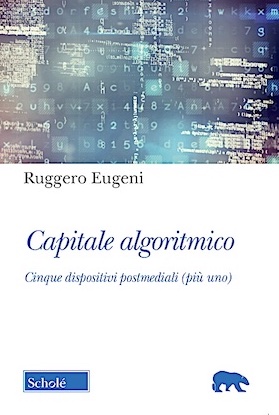
Cosa facciamo oggi con le immagini? E soprattutto, che cosa le immagini fanno con noi e di noi? Questo libro cerca una risposta mediante l’analisi di cinque dispositivi (più uno): gli smart glasses, le camere a campo di luce, i visori notturni, la realtà aumentata, le reti neurali e la fotomicrografia elettronico-digitale. Le immagini computazionali, chiamate in queste pagine algoritmi, nascono dalla connessione di risorse appartenenti alla economia politica della luce e del visuale con quelle proprie dell’economia della informazione e dei dati. Esse sono dunque, al tempo stesso, oggetti e strumenti della produzione, estrazione e distribuzione delle risorse comuni. Il “capitale algoritmico” emerge in tal modo come la reale posta in gioco della condizione postmediale.
Augmented Reality Filters and the Faces as Brands: Personal Identities and Marketing Strategies in the Age of Algorithmic Images
Ruggero Eugeni, “Augmented Reality Filters and the Faces as Brands: Personal Identities and Marketing Strategies in the Age of Algorithmic Images”, in Gabriele Meiselwitz (ed.), Social Computing and Social Media: Applications in Education and Commerce (Part II), HCI International 2022 Conference Proceedings, vol. 15, Cham, Springer, 2022, pp. 291–302. DOI 10.1007/978-3-031-05064-0_17

This paper analyzes the so-called “augmented reality filters” (ARF), a technology that makes it possible to produce and spread widely on social media a particular type of video selfies that are manipulated live while filming – for example, by modifying the somatic characters of the producer’s face. The first part of the paper analyzes ARFs in the light of a socio-semiotics of dispositives. This approach makes it possible to identify three interconnected aspects of ARFs: their technological consistency, which is closer to mixed reality than to augmented reality; their socio-psychological uses, and in particular personal identity construction through body image manipulation; and finally, their economic-political implications, linked to face recognition and social surveillance. The second part of the paper focuses on the marketing uses of ARFs and, in particular, on branded ARFs transforming users’ faces. In these cases, the radical involvement of brands in defining the identity of users requires a profound rethinking of the mechanisms of trust that bind them to consumers
The Artificial Intelligence of a machine: Moving images in the age of algorithms
Patricia Pisters, Ruggero Eugeni, “The Artificial Intelligence of a machine: Moving images in the age of algorithms”, Introduction to the NECSUS_European Journal of Media Studies Spring 2020, July 6, 2020, Special section #Intelligence, dedicated to the relationships between media, algorithms and Artificial Intelligence
Technologically Modified Self–Centred Worlds. Modes of Presence as Effects of Sense in Virtual, Augmented, Mixed and Extended Reality
Ruggero Eugeni, Valentino Catricalà, “Technologically Modified Self–Centred Worlds. Modes of Presence as Effects of Sense in Virtual, Augmented, Mixed and Extended Reality”, in Federico Biggio, Victoria Dos Santos, Gianmarco Thierry Giuliana (eds.), Meaning–Making in Extended Reality, Canterano (RM), Aracne, 2020, pp. 63-90 ISBN 9788825534320.
DOI 10.4399/97888255343204
This paper aims to consider different forms of extended reality (virtual, augmented and mixed reality) as manifestations of “technologically modified self–centered worlds (Umwelte)”. Consequently, the problems of the subject’s presence into the world and that of the mutual world’s presence with respect to the subject, becomes central. From this perspective, we argue that different ex-tended reality technologies constitute different “modes of presence” for the user; and that these modes of presence, conceived as meaning effects, are linked to specific enunciative configurations implied by the hardware and implemented by the software of extended reality dispositives. The paper consists of two parts: the first one examines the development of various forms of extended reality and their uses in the art world, with a specific focus on Jakob Kundst Steensten’s work. The result of the first part is a reasoned classification of extended reality forms, which distinguishes between bystanding media (e.g. cinema), bystanding–immersive media (e.g. hypertexts, video games, and various forms of augmented reality), moderate immersive media (e.g. cinematic virtual reality) and radical immersive media (e.g. mixed reality). The second part analyzes various debates conducted in recent years on the concept of “presence” in the field of engineering and VR psychology, media studies, philosophy and semiotics. It then resumes the classification previously introduced in order to highlight how the modulation of different roles of co–enunciator entrusted to the user determines in each case different modes of presence in technologically modified self–centered worlds.
A Short yet Complete History of Italian Film Theory
“Cinema: Theoretical Discourses”, in Fausto Colombo (ed.), Media and Communication in Italy. Historical. Historical and Theoretical Perspective, Milano, Vita & Pensiero, 2019, pp. 31-45
Tags: film theory; media theory; film studies;
The Post-advertising Condition. A Socio-Semiotic and Semio-Pragmatic Approach to Algorithmic Capitalism
Ruggero Eugeni, “The Post-advertising Condition. A Socio-Semiotic and Semio-Pragmatic Approach to Algorithmic Capitalism”, in Gabriele Meiselwitz (Ed.), Social Computing and Social media. Communication and Social Communities. 11th International Conference SCSM 2019, Vol. 2, part 2, Cham, Springer Nature, 2019, pp. 291–302,
https://doi.org/10.1007/978-3-030-21905-5_23
Lytro. The camera as hypersensor
in Comunicazioni sociali, n. 1, 2016, pp. 115-123, ISSN 0392-8667
Tags: plenoptic camera; sensors; light-field technology; computational photography;
Film and Enunciation
Entry of Edward Branigan, Warren Buckland (eds.), The Routledge Encyclopedia of Film Theory, London – New York, Routledge, 2014, pp. 157-161, ISBN 9780415781800
Tags: film studies; media studies; film semiotics; media semiotics; enunciation;
Film and Rhetoric
Entry of Edward Branigan, Warren Buckland (eds.), The Routledge Encyclopedia of Film Theory, London – New York, Routledge, 2014, pp. 408-412, ISBN 9780415781800
Tags: film studies; media studies; film semiotics; media semiotics; rhetoric of film; psychanalysis of cinema
Glassroots surveillance. Google Glass as dispositive and apparatus
Paper presented at the 2013 NECS Conference Media Politics / Political Media, Prague, June 20-22.
Tags: Google Glass; Postmedia condition; surveillance; dispositive; apparatus
First-person shot. Technology and New Forms of Subjectivity in Post-cinema Landscape.
Paper originally presented at the Conference “The Impact of Technological Innovations on the Historiography and Theory of Cinema” Montreal, November 1-6 2011. This text, entirely re-written, has been published in French as “Le plan à la première personne. Technologie et subjectivité dans le paysage postcinematographique”, in André Gaudreault et Martin Lefebvre (dirs.), Techniques et technologies di cinéma. Modalités, usages et pratiques des dispositifs cinématographiques à travers l’histoire, Rennes, Presses Universitaires de Rennes, 2015, pp. 195-208 ISBN 9782753535763 ISSN 21035407; and in English as “Remediating the presence. First person Shot and post-cinematic subjectivity”, in Tiziana Migliore (ed.), Rimediazioni. Immagini interattive. Tomo 1, Ariccia (RM), Aracne, 2016, pp. 205-218, ISBN 9788854893320 DOI 10.4399/978885489332011
Tags: media; experience, semiotics; first person shot; videogames; subject; subjectivity
Nikeplatz. The Urban Space as a New Medium
Paper presented at NECS 4th annual conference, Istanbul (Turkey) Kadir Has University, 26 giugno 2010 and at Université d’été de l’Université Sorbonne Nouvelle – Paris 3, Cinéma et art contemporaine 3, Paris, Institut National de l’Histoire de l’Art (INHA), 7 luglio 2010.
Tags: semiotics; experience; sociability; urban space; global cities; territory; Eva and Franco Mattes;
 Media | Experience | Semiotics